
Pima County Court Records After Arrest
After a Pima County jail arrest, the roster and the court record are linked but separate. The jail roster shows current custody, booking number, housing location, total bond, and court reference rows. The court record shows the charging document, filed charges, hearings, minute entries, plea agreements, judgments, sentencing entries, and disposition. A person may appear in the jail before the prosecutor files final charges, and the final court record may differ from the arrest or booking reason.
The Pima County Attorney's Office Criminal Division prosecutes adult felonies committed in Pima County, juvenile offenses within the county, and misdemeanors committed outside city limits. Misdemeanor Unit cases include criminal traffic, reckless or aggressive driving, property crimes, game and fish offenses, domestic violence, and DUI cited into Pima County Justice Court. For custody and booking details, use Pima County jail inmate records. For booking-photo questions, use Pima County jail mugshots.
From Jail Arrest to Court Filing
The practical path is arrest, booking, first appearance, prosecutor review, and court filing. PCSD court information says initial appearances are conducted by video court twice daily, with morning and evening sessions. If the judge orders release, processing happens after the session and can take time. The court case may open in Superior Court, Pima County Consolidated Justice Court, Tucson City Court, or another municipal court depending on the charge, agency, and jurisdiction.
- Search the PCSD roster and copy the court or reference number exactly.
- Match the court label to the correct portal: Superior Court, Justice Court, city court, or statewide public access.
- Search by defendant name, case number, or complaint number where the portal allows it.
- Review the charging document, current charge status, next hearing, bond entries, and disposition.
- Request official copies from the clerk when the web portal is incomplete or unofficial.
The roster can show a Superior Court CR-style reference, a Tucson City Court CM-style reference, or a Justice Court reference. That small label is often the key to the correct Pima County court records after arrest search.
Pima County Justice Court Records
The Pima County Consolidated Justice Court Case Search is a public, non-registered search portal with reCAPTCHA. It states that online information is not an official court record and may change. It excludes some protected matters, felony cases, and criminal or traffic cases where the defendant is a juvenile. If a person or case does not appear, the court points users to customer service, contact options, or the courthouse.
| Field Label | Type | Notes |
|---|---|---|
| By Name | Radio option | Enables name search. |
| Last Name / Business Name | Text | Main party-name field. |
| First Name | Text | Narrows a person search. |
| By Case Number | Radio option | Full case number should start with CR, CV, or TR. |
| By Complaint Number | Radio option | Searches by complaint or citation number. |
| reCAPTCHA | Challenge | Required before search. |
The Justice Court case-search interface is shown below.
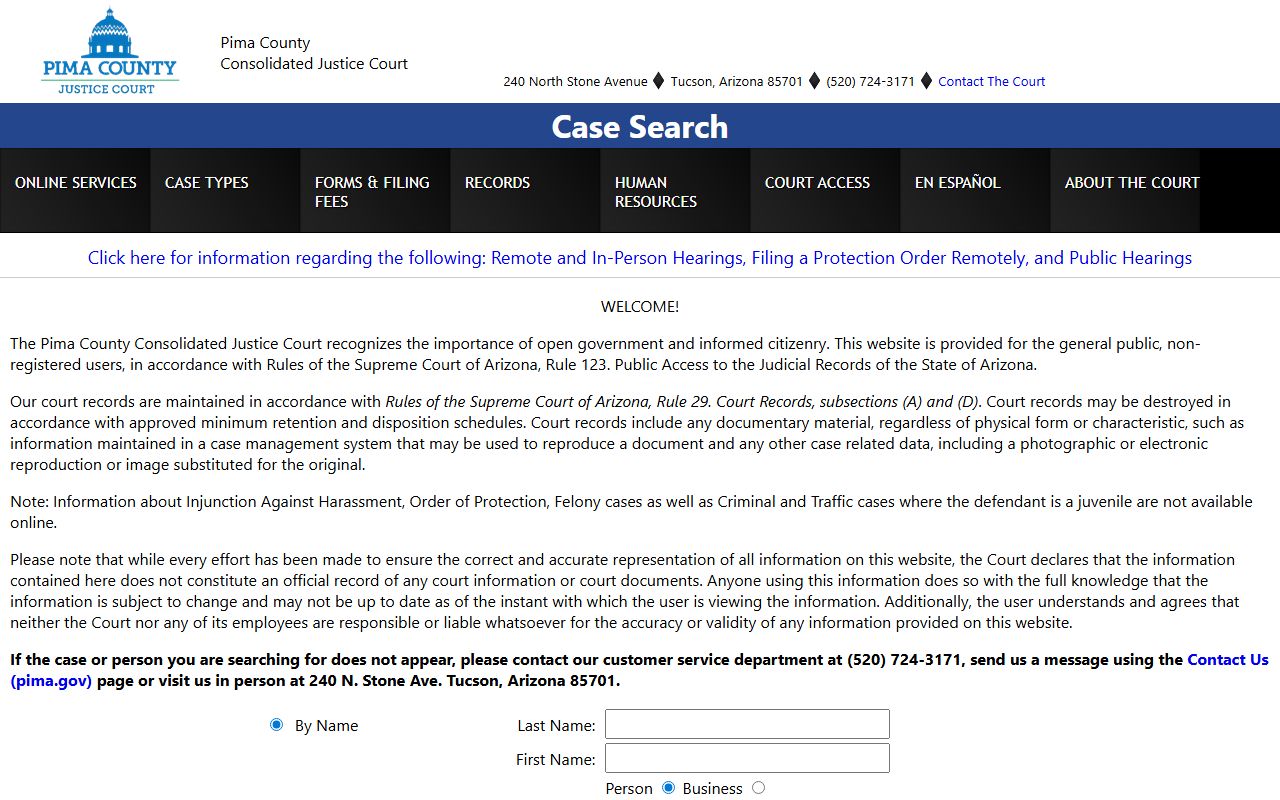
This portal is most useful when the jail roster reference points to a Justice Court, misdemeanor, DUI, traffic, or complaint-number path.
Pima County Superior Court Records
Felony criminal cases and more serious matters generally route to Arizona Superior Court in Pima County. The Clerk of Superior Court provides case-record access through its case records page and PublicDocs search. The Clerk says public access may include criminal, civil, family, probate, guardianship, and marriage-license case records, but the online display is not the same as a certified court record. Sealed, confidential, closed, or legally restricted records may be unavailable.
The Clerk's captured public search fields include last or business name, first name or initial, case number, a name-search mini-list option, and a search-group choice for case number or name. The Clerk recommends using public records services for official copies, and research captured Superior Court / Clerk public record services at 110 W. Congress St., Tucson, AZ 85701, with general/case information at (520) 724-4200 and Clerk contact at (520) 724-3200.
The Pima Superior Court Clerk public-document search portal is shown here.
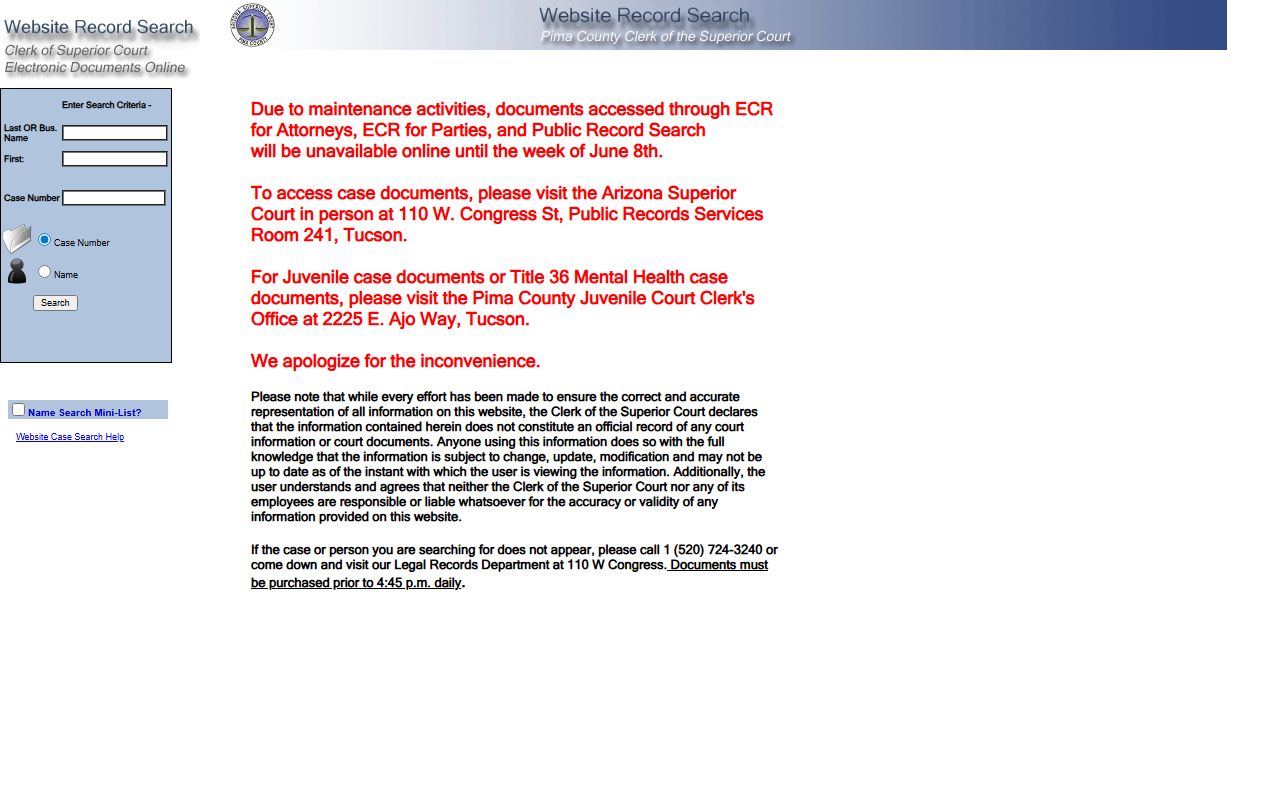
Use the Clerk when the court record after arrest needs formal copies, minute entries, plea agreements, judgments, or sentencing entries.
Arizona Court Records After Arrest
The Arizona Judicial Branch Public Access to Court Information portal is useful when the exact Pima court is unclear or when a case may have moved across court systems. The portal requires verification words. Its notices state that information can change, is not the official record, may omit some participating-court cases, and should be verified against official court records. The portal says case information is updated weekly.
The statewide public access portal screenshot from Arizona Judicial Branch Public Access appears below.
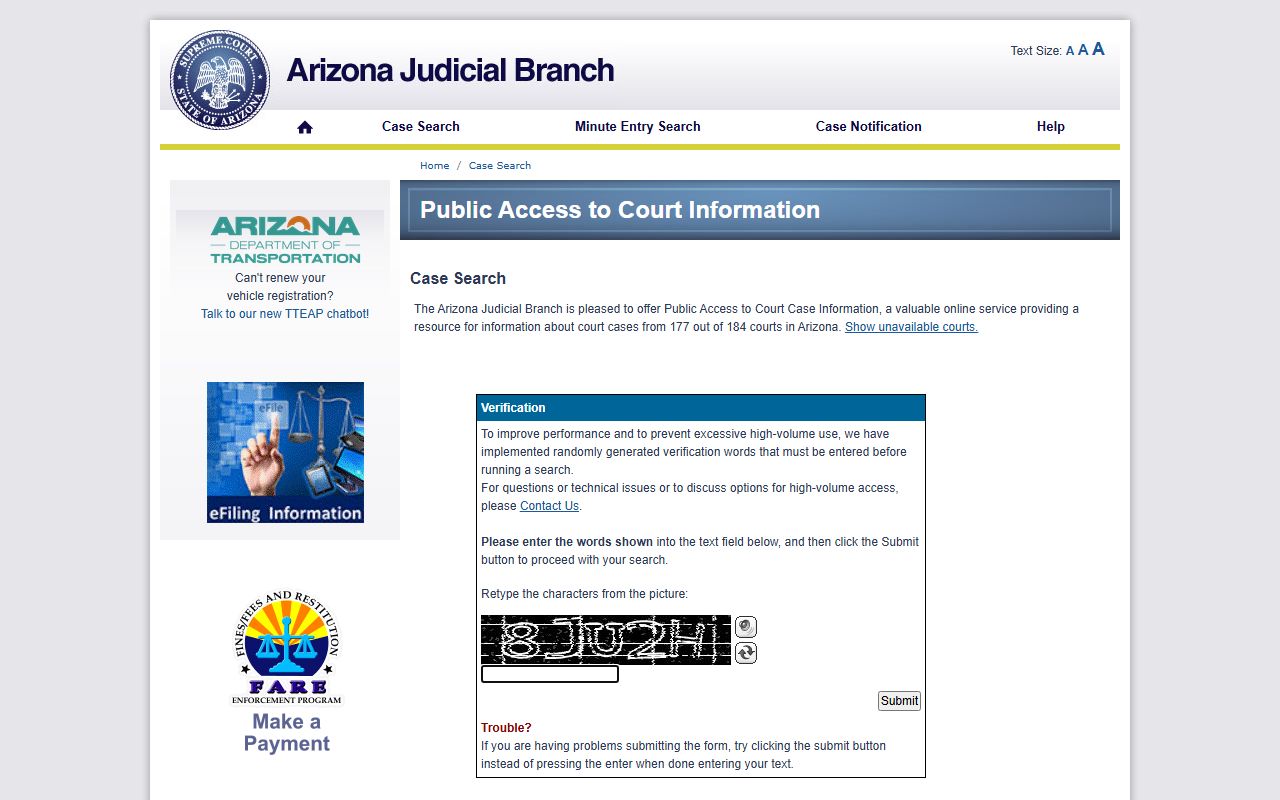
Statewide search helps bridge gaps, but the official record still comes from the court or clerk that maintains the case.
Pima County Arrest Charging Documents
The charging document is where the court record after a jail arrest becomes formal. The jail roster may show a reference and bond line before all filings are complete. A prosecutor can file a complaint or information, or a grand jury can return an indictment. Charges can be amended, reduced, dismissed, or supplemented as the case moves forward.
| Document | Who Uses It | Plain Meaning |
|---|---|---|
| Complaint | Officer or prosecutor | Often starts early-stage or lower-court charges. |
| Information | Prosecutor | Formal prosecutor-filed charges after probable-cause or preliminary processes. |
| Indictment | Grand jury | Grand-jury charging document, common in serious felony cases. |
Pima County Charge Status
Charge status is not the same as custody status. The roster may show someone in jail with a bond line while the court record shows whether a charge is pending, amended, dismissed, resolved by plea, or sentenced. A Hold Without Bond line on the roster is also not a conviction. It means release may require court action or resolution of another hold.
| Status | What It Means |
|---|---|
| Pending | The charge or case remains open and has not reached final disposition. |
| Amended | The prosecutor or court record changed the filed charge. |
| Reduced | The filed charge was lowered to a lesser offense or level. |
| Dismissed | The charge was dropped by court action or prosecutor decision. |
| Disposition | The final case result, such as conviction, acquittal, dismissal, plea, or sentence. |
Note: Use the court disposition, not the jail roster entry, when deciding whether an arrest led to a conviction.
Bond After Pima County Arrest
PCSD's bond page says bail bonds are accepted at the Inmate Accounts Office in the main lobby of the Pima County Adult Detention Complex. Surety and currency bonds posted by bail bond agents are accepted at the account window, and cash, credit, and debit card transactions can be made at lobby kiosks. Online and phone payments use TouchPay / GTL Financial Services. PCSD states that most bond transactions are processed within the hour, but release may take longer and does not occur during certain overnight hours.
| Bond Type or Hold | Pima County Meaning |
|---|---|
| Cash | Paid directly through an allowed jail or payment channel when permitted. |
| Cash or Secured | Roster-observed bond type that may allow payment or secured bond if no other hold blocks release. |
| Surety | Posted by a licensed bail bond agent. |
| PR / Own Recognizance | Court-ordered release on promise to appear, sometimes with conditions. |
| Hold Without Bond | No-release status for that reference until a court or agency resolves it. |
| Other jurisdiction hold | Another court or agency may keep the person in custody. |
Warrants Before a Pima County Arrest
No single official PCSD public active-warrant list was located in the research. Pima County's official warrant-resolution page directs people to court websites, Arizona public court access, and Pima County Pretrial Services. The no-cost phone path is to call Pretrial Services at (520) 724-3310 and request a warrant check. For felony probation warrants, Adult Probation's Clear My Warrant process uses (520) 724-9868.
A warrant can lead to a jail booking, and the jail roster may then show a court reference, bond type, or no-bond hold. Justice Court calendars also include warrant-related case types such as Arrest Warrant, Felony Warrants, Miscellaneous Search Warrants, and Sealed Record. A calendar entry is not the same as warrant-clearing instructions. Confirm the next step with the issuing court, Pretrial Services, Adult Probation, or counsel.
The Pima County warrant-resolution page is shown below.
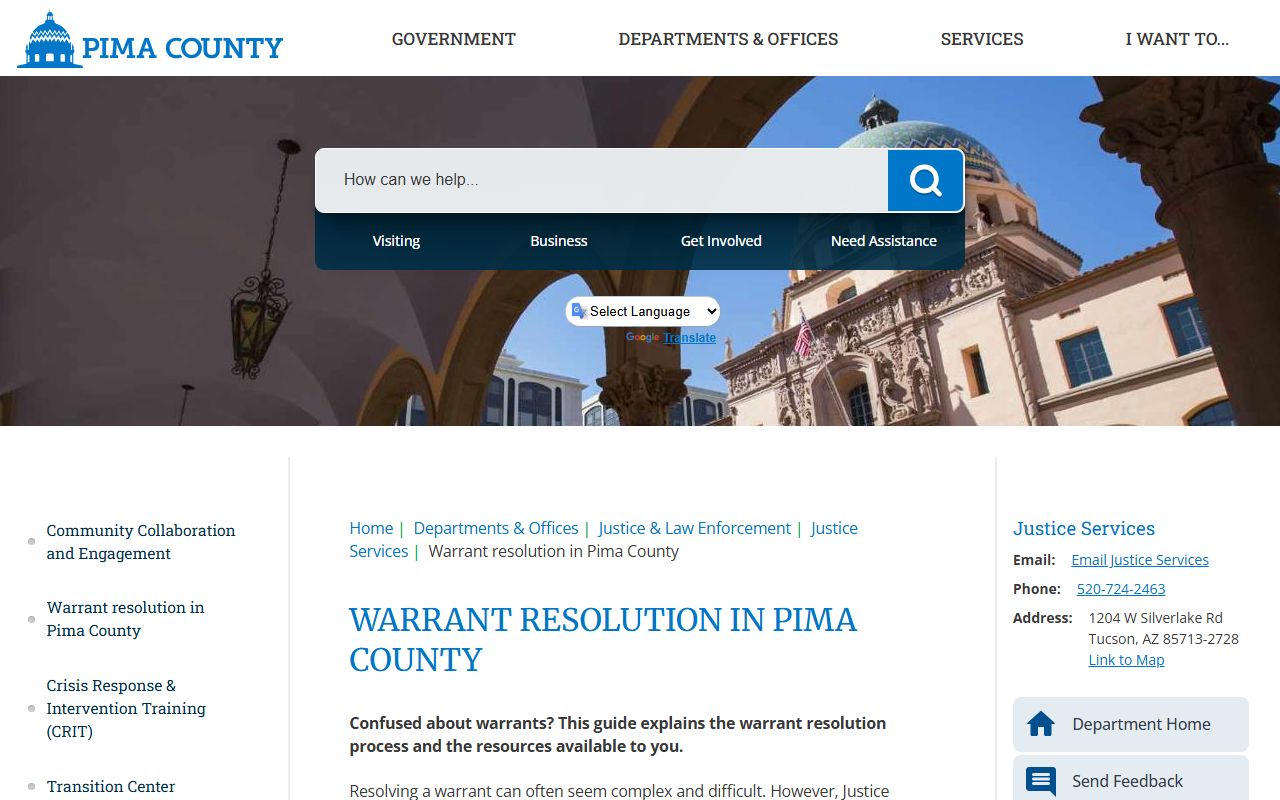
This source is useful because it avoids overstating online warrant access and points readers to the correct local phone process.
Charges vs Convictions
A charge is an accusation filed in court. A conviction is a final result after a guilty plea, verdict, or other qualifying adjudication. Pima County court records after arrest may show both, but they do not mean the same thing. The roster's custody and bond fields are even earlier in the process and should not be treated as conviction records.
| Charge | Conviction | |
|---|---|---|
| Stage | Accusation or filed count. | Final outcome after plea, trial, or court finding. |
| Proof level | Lower threshold, such as probable cause or filed allegation. | Beyond a reasonable doubt or a valid plea. |
| Where confirmed | Complaint, information, indictment, docket, or minute entry. | Judgment, sentencing entry, disposition, or certified court record. |
Sealed vs Expunged Arrest Records
Arizona uses record sealing for eligible arrest, conviction, and sentencing records under A.R.S. 13-911. A sealed record is restricted from ordinary public access but may remain available to justice agencies and under statutory exceptions. Expungement is a broader term often used by the public, but the Pima County court path should be tied to the actual Arizona sealing statute unless a different case-specific law applies.
| Sealed | Expunged | |
|---|---|---|
| Public access | Restricted by court order when eligible. | Often used to mean removed or treated as erased, but Arizona sealing is the cited path here. |
| Agency access | Justice agencies may retain limited access under law. | Depends on the specific statute and record type. |
| Pima County next step | Review case disposition and petition the court when eligible. | Do not assume expungement applies without a statute or court order. |
Restricted Pima County Court Records
Arizona public access starts broadly under A.R.S. 39-121 and A.R.S. 39-121.01, but court and jail records can still be restricted. Juvenile cases, sealed records, protective-order matters, confidential filings, ongoing investigations, victim information, medical records, security video, visitation video, and telephone recordings may be withheld, redacted, or require a formal release, subpoena, or court order.
PCSD materials identify Sheriff Chris Nanos as the current sheriff, but court records after a Pima County jail arrest are maintained by courts and clerks rather than by the sheriff alone.
Background-check use is a separate issue. Public court records after a jail arrest may be useful for personal verification, but consumer reporting, employment, tenant screening, credit, and insurance decisions are regulated by the Fair Credit Reporting Act and other laws. Use official court copies and compliant background-check providers for regulated decisions.